What Stains Can Pressure Washing Remove?
Here's the short, honest answer to what stains pressure washing removes: anything living on the surface — mold, algae, mildew, dirt — comes off easily. Anything that has chemically bonded with or soaked into the concrete — oil, rust, fertilizer, old red clay — usually needs the right treatment first, not just more pressure. And a few stains are simply permanent. Let me walk you through which is which so you know what to expect before I ever pull up to your Bradenton driveway.
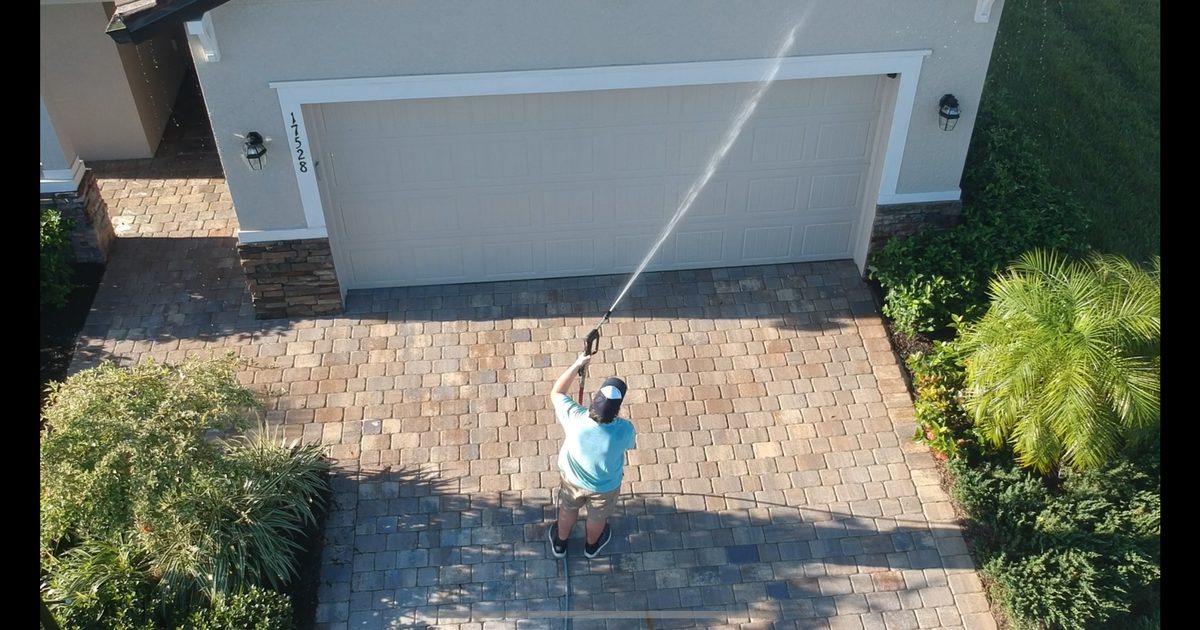
Stains pressure washing removes easily
The good news first. In humid Florida, the most common thing darkening a driveway isn't really a "stain" at all — it's organic growth. Our climate grows mold, mildew, algae and that green-black film fast, especially on shaded and north-facing concrete. This is exactly what pressure washing (paired with a proper pretreatment) was built for:
- Mold, mildew and algae — the gray-green-black film on driveways, walks and pavers
- Dirt, mud and general grime from weather and foot traffic
- Leaf and tannin staining from oak leaves and acorns sitting on concrete
- Cobwebs, pollen and surface dust on hard surfaces
On delicate surfaces like siding and pool screens, the same organic growth comes off with a gentle soft wash instead of high pressure — low pressure plus a cleaning solution that kills the growth at the root. For concrete, the high-pressure surface cleaner in our driveway & concrete cleaning package takes that film off and brings the slab back to a brilliant white.
Stains that need a treatment, not just pressure
This is where most people get frustrated trying to do it themselves. The next group of stains has chemically bonded with the concrete or soaked deep into its pores. Blasting harder doesn't help — it just etches the surface while the stain stays put. Each of these needs the correct chemistry applied first:
Oil and grease
Oil dripping from a car or mower soaks straight into porous concrete. The fix is a degreaser pretreatment that draws the oil back up out of the pores, followed by a hot-water surface clean. Fresh spills lift well. A years-old oil shadow under the same parking spot will lighten dramatically — but be honest with yourself, the deepest of those may not vanish to zero.
Rust, irrigation and fertilizer stains
Those orange-brown streaks fanning across a driveway are usually from sprinkler water (iron in well water) or fertilizer granules that landed on the concrete and reacted. They're a chemical stain, not surface dirt, so pressure alone does nothing. They need a rust remover — typically an oxalic-acid-based treatment — that dissolves the staining, then a thorough rinse. Many come out completely; severe, long-set rust may fade rather than fully disappear.
Red clay, tire marks and battery acid
These vary case by case. Red clay (common on new-construction lots around Lakewood Ranch and Parrish) rinses off easily when fresh, but once it's been ground in and sun-baked it stains the pores and needs a dedicated cleaner. Tire marks and scuff rubber usually respond to a degreaser and heat. Battery acid and other chemical spills actually etch and discolor the concrete itself — that damage is in the slab, so cleaning can improve the look but can't undo etching.
What pressure washing can't fix (the honest part)
Good expertise means telling you when to stop. A few things won't come out no matter who you hire, and you deserve to hear that up front rather than pay for a miracle that isn't coming:
- Etching and surface damage — once acid or careless high pressure has carved into concrete, that texture is permanent. (More on that in does pressure washing damage concrete?)
- Deep, decades-old oil shadows — these lighten a lot but may leave a faint ghost.
- Discoloration and spalling from age or freeze cycles — that's the concrete itself, not a stain on top of it.
And one I'll say plainly: never high-pressure a roof. Roof shingles get an algae film here too, but blasting them with pressure tears the granules off and voids warranties — that's a soft-wash job, and not one of the services we offer. Matching the method to the surface is the entire game.
The bottom line on what stains pressure washing removes
If it's living growth or surface grime, pressure washing clears it and your concrete looks new again. If it's oil, rust or set-in clay, the right pretreatment chemistry does the heavy lifting and the results are usually excellent. If it's etched, spalled or decades deep, an honest pro tells you so instead of overselling. Either way, the safest move is to let someone look at it first — Florida's humidity means whatever's growing now will only spread, so an annual clean keeps it from ever getting that bad.